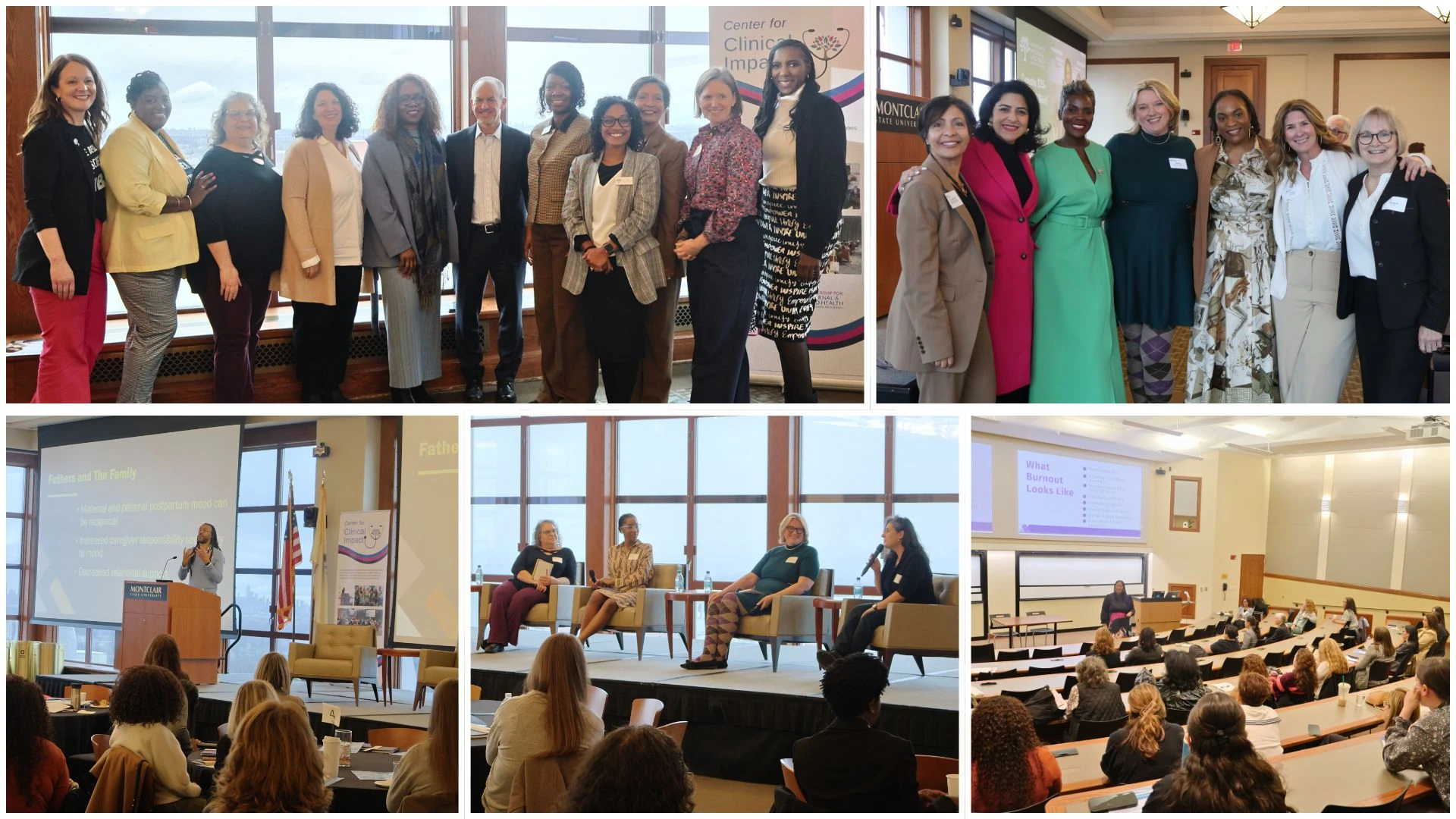
Interdisciplinary. Collaborative. Community-driven. Comprehensive care. These themes defined the 9th annual Maternal Health and Perinatal Safety Symposium, hosted by the Partnership’s Center for Clinical Impact at Montclair State University on March 12, 2026. The sold-out event united health professionals, including nurses, obstetricians, midwives, doulas, community health workers, social workers, therapists, public health leaders, policy makers, and more, to build the future of maternal and child health in New Jersey and beyond.
Mariekarl Vilceus-Talty, MA, BSN, President and CEO at the Partnership, opened the Symposium, saying, “We bring together clinical medicine, community leaders, advocacy, research, and lived experience, because we know that maternal health and safety does not happen in silos. We know that it happens when hospitals partner with communities, when data meets lived experience, when policymakers listen to those closest to the work, when doulas, nurses, clinicians, and families are seen as architects of that system.” She continued, “I assure you that the systems that we build together — dignity, humanity, strategy, safety — are for every mother, every baby, every family.”
None of this would have been possible without our outstanding sponsors. We are incredibly grateful for the support of our 2026 Maternal Health and Perinatal Safety Symposium Sponsors, including lead sponsor Atlantic Health System, Wellpoint, Hackensack Meridian Health, Flourish Care, My Swaddle, and Family Health Initiatives. Their generosity supports professional education and innovation in maternal and child health, enabling us to learn from renowned maternal and perinatal healthcare experts across the country.
Healthcare Leaders Unite to Shape the Future of Maternal and Child Health at Our 2026 Symposium
The energy in the ballroom at Montclair State University last Thursday was electric. Filled with maternal and child healthcare professionals, attendees and speakers alike were ready to learn, inspire, and innovate together.
Welcome speaker Iris Jones, MA, LPC, LCAD, NCC, CCS, Assistant Commissioner, Division of Family Health Services, New Jersey Department of Health, underscored that energy with a riveting opening address.
“I wanted to remind all of you today that this work doesn’t just belong to one discipline. It belongs to no one and everyone. Everyone needs a voice at the table,” Jones said. She concluded, “I am so grateful to the Partnership for pulling this together today. For reminding me that even when my days are tough, and it feels like things are going backward, there are people who are in this with me.”
Jones’ thoughtful remarks were an excellent introduction to the day’s overarching ideas. Though each speaker covered diverse concepts in maternal health and perinatal safety, the consensus was clear – the more we work together and learn from one another, the better care we can provide and the better changes we can create.
Community-Driven Care Takes Center Stage
Next, keynote speaker Dr. Ebony Carter spoke passionately about “The Power of Process: Designing Health with – not for – Communities,” citing her work with the EleVATE ( Elevating Voices, Addressing Depression, Toxic Stress and Equity) Collaborative, a St. Louis–based group prenatal care program that incorporates trauma-informed care and behavioral health services.
Carter highlighted the importance of collaboration: “One thing is that it had to be transdisciplinary, cross-institutional collaborative work,” she said. “Engaging a community, which means listening to community voices, can even be catalyzing. Thinking specifically, not burying race, but acknowledging the role of race.”
Carter emphasized the need to consider who may be missing from healthcare discussions and to bring those voices into the conversation, with the aim of eliminating racial and ethnic disparities.
The Intersection of Paternal Mental Health and Maternal Health & Perinatal Safety
Following Carter’s keynote, Tyce Nadrich, PhD, LMHC-D, LPC, ACS, NCC, Mercer University, Balancing Mental Health Counseling, addressed the often-overlooked importance of paternal mental health and fatherhood.
“Focusing on the mental health of men and fathers contributes to our understanding of maternal health and perinatal safety,” Nadrich emphasized, noting that maternal and paternal postpartum mood can be reciprocal.
Nadrich suggested many research-backed ways to improve paternal mental health and fatherhood outcomes. Suggestions included shifting the dyad from “mother-infant” to a triad, “mother-father-infant,” participating in peer and professional support, starting engagement early, engaging with fathers’ excitement while providing realistic expectations, and inquiring about the physical and mental health of everyone in the triad.
Interactive Breakout Sessions at the Maternal Health & Perinatal Safety Symposium
The Symposium continued with three captivating breakout sessions featuring Chanta Blue, MSW, Med, LCSW, SCT, Blue Counseling & Wellness Center, Denise Bolds, MSW, Ed.D. CD(DONA), CLC, CBE, Black Women do VBAC, and Todd Rosen, MD, RWJBarnabas Health, Jersey City Medical Center. Each session was equally invigorating, with attendees enthusiastically taking part in the intimate, hands-on learning.
Symposium attendee Yessenia Mercedes raved about Bolds’ presentation, “Care for Patients & Research on VBACs (Vaginal Birth After Cesarean).” Mercedes was inspired by what she learned, noting a key takeaway: “It really matters that birthing individuals feel empowered and informed about all the different ways they can give birth.”
Marise Angibeau-Gray, a Certified Doula and Lactation Support Counselor who attended Dr. Rosen’s talk, “Fetal Monitoring on Trial,” said she enjoyed the collaborative, human-centered approach of the presentation. Angibeau-Gray noted that, as a doula, healthcare systems can be tough to navigate and even unwelcoming at times. Hearing Dr. Rosen speak gave Angibeau-Gray renewed energy and optimism for both interdisciplinary collaboration between doulas and hospital staff and comprehensive-care-based system changes that will improve health equity.
Blue’s presentation, “Pleasure as Practice: Reclaiming Joy in the Work of Care,” sparked a lively discussion on burnout and practical ways to reclaim joy.
“Pleasure is both our right and our responsibility,” emphasized Blue.
Attendees called Blue’s session energizing, inspiring, and actionable. Many nurses and maternal care professionals said the session addressed the challenges of their demanding roles and validated their experiences. Attendees felt seen and heard.
Following the breakout sessions, the afternoon included two panels: “Navigating Reproductive Healthcare Law: Implications for New Jersey Professionals” and “Highlighting New Jersey Initiatives.” There was also an impassioned presentation on “The Current Status of Maternal Morbidity and Mortality: NJ and U.S.” by Eugene Declercq, PhD, Boston University School of Public Health.
Navigating Reproductive Healthcare Law Panel Discussion
Echoing the themes discussed throughout the day, the panel on reproductive healthcare highlighted the interdisciplinary work and comprehensive care necessary to ensure reproductive health equity. From doctors and nurses to community care workers to policymakers, public health officials, social workers, and community members, working together is key.
“People need to be involved in their licensing boards and in other public service opportunities. If you feel close to your community and are able to represent it, and you have an expertise to offer, there are a whole lot of spaces for civic engagement,” said panelist Magda Schaler-Haynes, JD, MPH, Professor of Health Policy and Management, Columbia University Irving Medical Center, Mailman School of Public Health.
The Current Status of Maternal Morbidity and Mortality
Declercq reiterated the importance of getting involved during his presentation, encouraging attendees to join advocacy groups doing incredible work in maternal and child health. He shared resources on key statistics and research his team has been collecting to monitor and improve the maternal morbidity and mortality crisis in the United States through the website birthbythenumbers.org.
Additionally, Declercq stressed the importance of listening to women and their experiences, and of crafting comprehensive care policies that keep women of all ages within the health and social systems.
“You know, the best way to deal with this is not to say, ‘We’re not gonna pay any attention to you until you get pregnant, and then we will really care about you a lot,’ it is to care about people because they’re people,” Declercq said.
Innovating And Driving Meaningful Changes in Maternal Health and Perinatal Safety
The Symposium ended with an enthralling panel discussion about New Jersey initiatives. As the panelists wrapped up and each gave a call to action, the general messages that reverberated throughout the day were once again underlined.
“I think my call to action would be around just breaking the siloing around maternity care and really thinking about more person-centered care. Not just centering the pregnancy itself, but the entire health experience,” remarked panelist Zeynep Uzumcu, MD, Faculty, Department of Family Medicine, Atlantic Health System, Overlook Medical Center.
Innovating and driving meaningful changes in maternal health and perinatal safety will require interdisciplinary, collaborative, community-driven, and comprehensive care-focused work.
“Spaces like this are how programs and collaborations are birthed, pun intended,” declared panelist Pamela Taylor, MPH, Maternal Care Quality Collaborative (MCQC) Program Manager, New Jersey Maternal & Infant Health Innovation Authority.
We amplify Taylor’s call to action. The Partnership is honored to offer programs for pregnant individuals, children, and families in Northern New Jersey. We collaborate with community partners, hospitals, healthcare professionals, social workers, educators, caregivers, policymakers, non-profit organizations, state agencies, advocacy groups, and more to provide comprehensive, community-driven care. Together, we are changing the paradigm in maternal and child health and ensuring that every family can not only survive but thrive.
A special thank you to the Montclair State University MCH Workforce Catalyst Program for their outstanding support.